Who Are You When You Speak English?
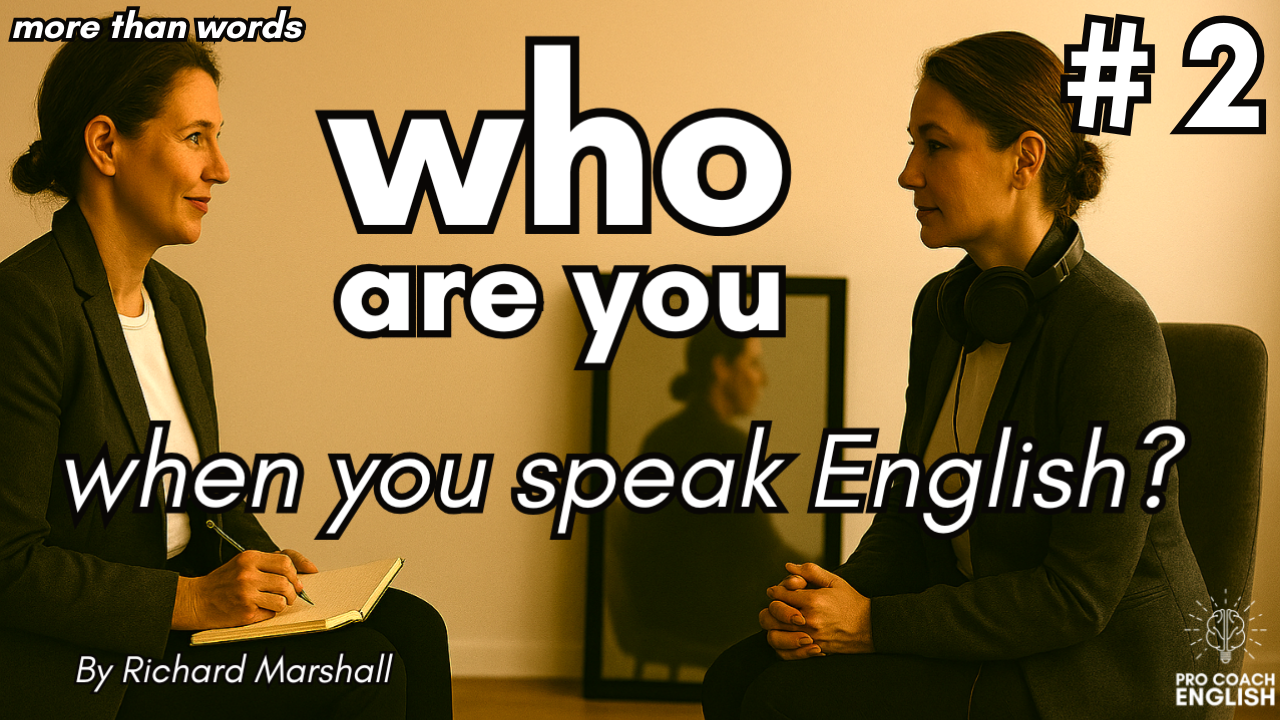
Who Are You When You Speak English?
October 9, 2025
How Speaking Another Language Confronts Your Sense of Self
There’s a particular kind of silence that arrives in the moment before you speak. A silence that doesn’t calm the nerves or steady the breath, but instead tightens around the chest like a weightless grip, holding you just beneath the surface of the language.
Your thoughts are there, intact and ready, but your voice lingers somewhere behind, still searching for the strength that will carry it forward.
That space between thought and speech holds a tension that’s difficult to name. A kind of emotional stillness where everything inside feels aligned, yet the words remain just out of reach.
And in that pause, something begins to emerge from underneath. It’s not hesitation in the traditional sense, but a still confrontation with the self.
Because for many Spanish-speaking professionals, speaking English reaches far beyond vocabulary lists and grammatical accuracy; it touches something more intimate.
It becomes a test of embodiment, a moment where you find yourself wondering whether the person stepping forward, the one forming sentences in a language that isn’t your own, still carries the essence of who you are.
Not the curated version built for approval. Not the performer trained to please. But the raw, unfiltered self you’ve spent a lifetime shaping through experience, resilience, and truth.
The Quiet Shift Inside
You didn’t arrive at this point by accident.
The person you are today was shaped over many years. Formed in choices made under pressure, through conversations that lingered long after they ended, and defined by moments that demanded something deeper than technical skill or superficial confidence.
Those moments didn’t ask for perfection. What they required was steadiness. The kind that holds its shape under pressure, the kind that stands firm when clarity is called for. And each time, you stepped into the room with a voice that didn’t aim to impress, but to connect.
You’ve guided teams through uncertainty, and held your ground in conversations that carried weight, moments where complexity wasn’t something to be avoided, but something to be held with care.
The trust you earned in those spaces didn’t come from the content of your words alone, but from the way they arrived: steady, attuned, and unmistakably yours.
There was empathy woven into your tone, gravity in your timing and an ease in your humour that made people feel safe in your company.
These weren’t tactics borrowed from a leadership manual. They were expressions of a self built through experience, refined over time, and carried forward with intention.
When Your Voice Feels Different
But when the language shifts, something subtle shifts with it.
Not in a way that others would notice, there’s no dramatic pause, no visible unraveling. But inside, it’s enough to feel like a part of you has gone quiet, as if the volume of your inner voice has been turned down without your consent.
You proceed with care, as if each word carries a load you’re not quite used to holding. The phrasing becomes more deliberate, the cadence of your ideas slows, and the voice that once moved with ease and conviction starts to feel unfamiliar. As though it’s been subtly reshaped to fit the contours of a language that doesn’t quite know your story.
This isn’t about vocabulary. You know the words. You’ve studied them, spoken them, lived with them long enough to navigate a conversation. But the emotional scaffolding that holds your identity together, the instinctive sense of self that rises when you speak without thinking, wasn’t built in English.
It was built in the language of your childhood, your culture, your emotional memory. And when that foundation shifts, even slightly, it’s enough to make your voice feel like it’s standing on borrowed ground.
Every time you speak, it’s never just about conveying information, it’s a quiet negotiation inside you. You find yourself asking whether the words you choose will reflect your competence without flattening your spontaneity. And wondering if being understood will come at the cost of losing the texture of who you are.
This balancing act, subtle, relentless, and often invisible to those around you, plays out day after day. And it’s this ongoing tension, more than any grammatical misstep, that makes speaking English feel so heavy. Because the real weight isn’t in the language itself, it’s in the constant effort for you to be yourself when you use it.
Reclaiming Presence
This tension, between fluency and familiarity, between sounding competent and feeling authentic, is rarely named, let alone explored.
Because most language advice is obsessed with performance: how to sound polished, how to avoid mistakes, how to impress. While quietly ignoring the deeper question that lives within us all. A quiet, persistent discomfort that asks:
“Will they see me?”
“Will they hear me?”
…not just the words, but the person behind them.
You want to enter the room as yourself, grounded and unmistakably present.
- Not performing.
- Not adjusting.
- Not translating.
Just speaking from the centre of who you are, without changing your personality to fit someone else’s idea of fluency.
And this longing, to feel like yourself when you speak, isn’t too much to ask. It’s not a privilege reserved for native speakers or language prodigies. It’s the baseline of what real communication should offer.
So if you’ve ever listened to yourself in English and thought:
I sound competent, but I don’t sound like me.
Then this is where the real work begins.
Not with grammar drills or pronunciation tweaks. But with the question that quietly shapes every conversation:
Who am I in this language, and how do I bring more of myself into it?
This isn’t a question with a quick answer. But noticing these moments of disconnection is the first step toward speaking more fully as yourself.
The work isn’t about perfection, it’s about authenticity, and the quiet satisfaction of feeling genuinely heard.
To be continued...
Thank you for reading the second essay in the 'More Than Words' collection.
Next week we will meet your Inner Team: The Controller, The Protector, and The Guide. You’ll learn how to recognise them, realign them, and speak from the part of you that feels most like you.
If you’re curious about how I help Spanish speakers transform the way they feel and perform in English, you can learn more about my work and the ways we can collaborate on my website. You’ll also find a collection of free resources, along with direct access to my bilingual podcast, From Lost to the River, where I interview language-acquisition experts, authors, and other fascinating voices in the communication world.
Have a wonderful day y un saludo! Richard
