The Voices Behind Your English
October 16, 2025
Meet Who Decides How You Speak
If the previous essays were about noticing the spaces where your voice feels restrained, this one is about who shows up in those spaces, and how to work with them instead of against them.
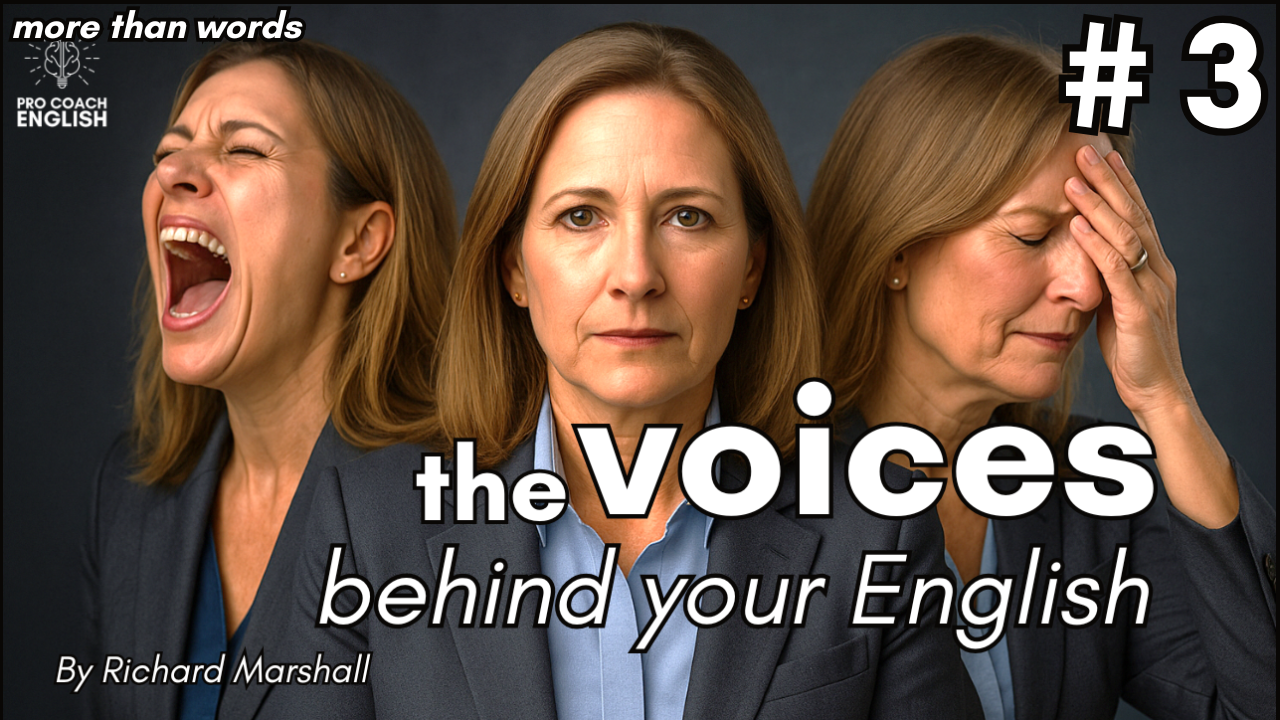
Because every time you step into English, there’s an audience you carry inside. A trio of forces, each with a voice, each with an agenda, each pulling you in a different direction. Let me introduce you to Your Inner Team.
The Controller:
This part of you is strict, relentless, and demanding. It holds the echoes of expectations you never consciously agreed to: messages absorbed from teachers, managers, cultural norms, and childhood scripts. It’s the voice that says:
“You should be better at this by now.”
“Don’t speak unless it’s perfect.”
“Everyone’s watching, don’t mess it up.”
It doesn’t mean to harm you. It thinks it’s protecting you. But in reality, it keeps you small. And when it takes over:
- Your voice hesitates.
- Your words become rehearsed.
- And ultimately, you disappear, letting the conversation pass you by.
The Protector:
This is the voice of tenderness and vulnerability. It remembers what it felt like to be embarrassed, misunderstood, or dismissed, ensuring those memories remain close, wrapped around you like a suit of armour.
It’s the voice that says:
“I’ll sound stupid.”
“They’re better than me.”
“Please don’t ask me a question.”
It’s not weak, it’s just wounded. And when this voice leads:
- You stay silent.
- You smile and nod your head while feeling disconnected.
- You leave a meeting wondering why you didn't speak up, even though you had something to say.
The Guide:
This is the voice of calm and clarity. It's the part of you that leads without effort. Confident in its own rhythm. Balanced, composed, and fully in charge of the moment.
It simply says:
“Let’s take a breath, you’ve got this.”
“Say what you know, you can always clarify.”
“You don’t need to impress. You just need to connect.”
This is the voice I guide my clients to strengthen, through deep emotional awareness, intentional practice, and self-trust.
When The Guide speaks:
- Your words land with authority.
- Your confidence radiates through the room.
- You begin to feel like yourself again.
Turning English from a Barrier into a Bridge
Learning to speak English with your Inner Team present isn’t about silencing The Controller or ignoring The Protector; it’s about listening to them, naming them, and choosing when and how each should influence your words.
The moment you recognise and acknowledge these voices without being overwhelmed, you begin to reclaim authority over your own communication.
Before a meeting, before a presentation, before a conversation where English feels more challenging than usual, you can pause, notice which voices are active, and bring in The Guide to steady the course.
And when that happens, the weight lifts. Not because grammar is perfect or vocabulary is endless, but because you are working with your own mind instead of fighting against it.
English evolves from a barrier to a bridge you actively cross, a moment where you can move through uncertainty with the tools you’ve carried all along.
The Way Forward
Let’s now explore how to recognise the triggers that push The Controller and The Protector into overdrive, and I’ll share with you some practical steps to let The Guide lead when it matters most.
Because until you can coordinate the Inner Team, your voice, however capable, will always be contending with the underlying interference of thoughts and fears you haven’t yet faced.
A Moment Inside Your Mind
Let me show you how this plays out in real time: You’re in a meeting. Someone asks you a question in English.
Inside, this happens:
- The Controller says: “You better get this right.”
- The Protector says: “I don’t know what to say. What if I freeze?”
- The Guide says: “Stop. Breathe. Say what you know.”
Now ask yourself:
"Which voice do you usually follow?"
If it’s The Controller or Protector, you’ll likely hesitate, go blank, or overthink every word.
If The Guide steps in, you’ll speak, even imperfectly, because you’re not judging yourself for it.
A Tool for Realignment

Here’s something I use with my clients, and with myself: Before you speak, ask yourself:
“Which part of me is leading right now? Is it the part that’s trying to…
protect me?
control me?
or support me?”
Then softly refocus by saying something grounding to yourself that restores your command over the moment:
“I’m allowed to take my time.”
“I don’t need to be perfect, I need to be present.”
“I can speak from where I am, not where I think I should be.”
This isn’t about pretending to be confident. It’s about choosing the voice that lets you act with intention.
Why This Matters
When we speak another language, it’s very common for us to regress emotionally, leaving us feeling small and exposed as our sense of safety is challenged. When The Protector is alarmed by fear, or The Controller intensifies its criticism and pressure, the nervous system responds.
That’s why your mind goes blank, why words vanish mid-sentence, why your face might flush, or your hands sweat. It’s not just nerves. It’s your whole self reacting to what feels like a threat. And if these inner voices aren’t managed, speech flows from fear as opposed to clarity, from pressure instead of choice.
Speaking from The Guide goes beyond confidence. It’s about centering yourself, calming the inner turbulence, and stepping fully into your own experience without distraction. As The Guide takes the lead, The Protector relaxes, The Controller loosens its grip, and clarity blooms.
Reflection Exercise: Rewriting the Moment
Think of a recent time when you wanted to speak English - but didn’t.
Ask yourself:
"What was I thinking?"
"What was I feeling?"
"Which voice was leading?"
Now rewrite that moment - from your Guide’s perspective:
What would that part of you have said or done differently?
What would it feel like to trust that voice more often?
In Summary
Every moment you pause to notice your Inner Team is a moment that you reclaim authority over your words, your choices, and the professional presence you bring to the room in English.
When you step aside from The Controller and The Protector, you make space for The Guide to lead the way. And in that space, English stops feeling like a challenge and becomes a tool you navigate with intention, poise, and trust in your own judgment.
To be continued…
Thank you for reading the third essay in the 'More Than Words' collection.
Next week, we’ll explore how to turn everyday English exposure into real learning opportunities, uncover strategies to make passive learning more effective, and see how small, consistent steps - like short TV-watching sessions - can steadily boost your fluency. By the end, you’ll have practical ways to integrate English naturally into your life, build confidence in understanding and speaking, and make progress without pressure or feeling overwhelmed.
If you’re curious about how I help Spanish speakers transform the way they feel and perform in English, you can learn more about my work and the ways we can collaborate on my website. You’ll also find a collection of free resources, along with direct access to my bilingual podcast, From Lost to the River, where I interview language-acquisition experts, authors, and other fascinating voices in the communication world.